Active Transport by Group Translocation
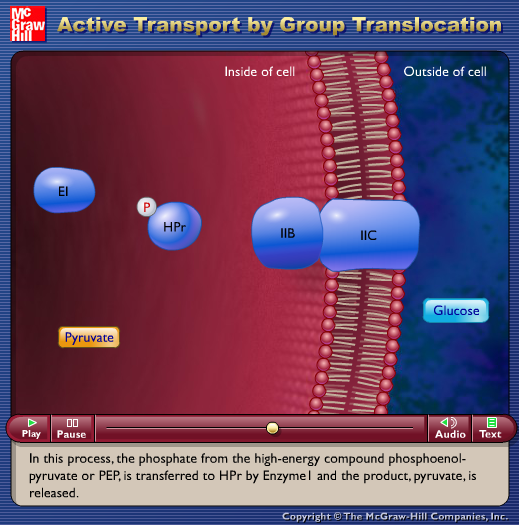
Why is phosphorylation such an efficient method of performing cellular work? Many cellular processes involve the transfer of phosphate groups from one molecule to another. This process is known as phosphorylation. The bonds between phosphate groups and other molecules are often referred to as high energy bonds. A relatively large amount of free energy is released when such a bond is broken. The breaking and reforming of bonds involving phosphate is a powerful mechanism for transferring energy or using energy to drive cellular processes such as transportation across membranes. In some cases a phosphate is cleaved from a molecule such as ATP to form ADP and inorganic phosphate in a reaction that is coupled to another reaction that requires an input of energy. In other cases the transfer of a phosphate may change the configuration of a molecule and cause a reaction. A series of reactions may pass a phosphate group from molecule to molecule, performing cellular work, such as active transport, with each phosphorylation.
Categories and tags of the game : Educational, Science, Single Player
💡 Dato Tecnológico
La monetización de juegos a menudo requiere conocimientos en marketing digital y SEO. Las agencias de publicidad utilizan software de análisis de datos para maximizar el retorno de inversión (ROI).